
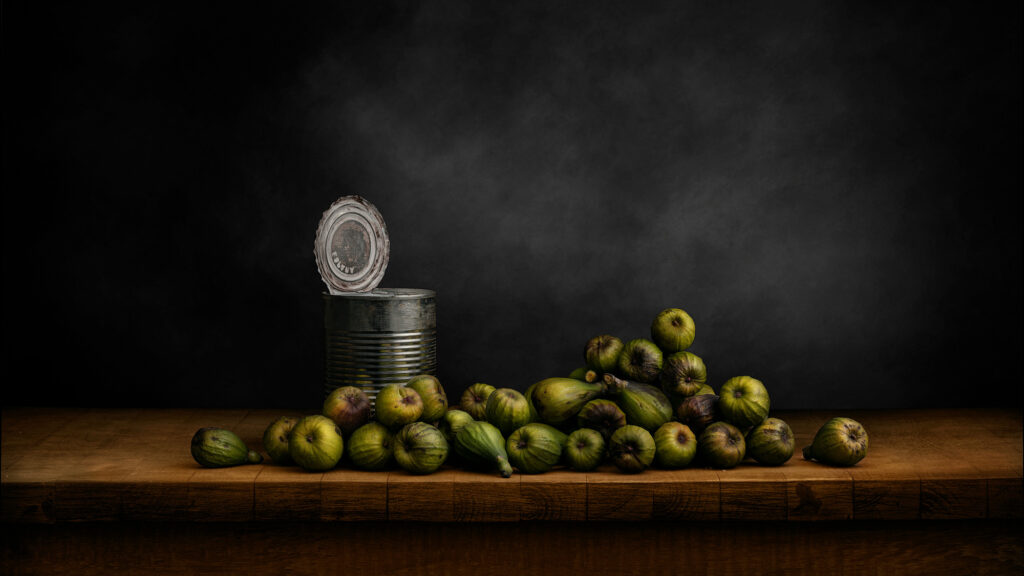
Why I shoot still lifes: creating instead of searching
Anyone visiting this website will likely notice why still life photography makes up a major part of my work and conceptual art. This is something that often draws attention because, like most photographers, for years I shot practically everything: landscapes, travel, everyday scenes, and people. So, why choose to focus on still lifes instead of other disciplines? The answer is simple: I prefer to build my own everyday realities and textures rather than going out to search for them.
So, why end up focusing on something apparently as simple as taking photos of things?
Finding a photograph vs. why still life photography is built
There are photographs that are out there, just waiting to be discovered.
In street photography, landscape, or even documentary work, you need to have a keen eye and know how to isolate the image from its surroundings. It requires recognizing an interesting composition within the visual chaos around you, anticipating a specific moment, and capturing a light that will never repeat itself. For that, you need a trained eye.
In a way, those photographs are found.
Still lifes work differently. Instead of discovering an image, we build it. Following the entire tradition of still life photography, we choose the objects, decide how they relate to one another, and select the background, textures, lighting, and every tiny detail within the frame. The photograph does not emerge from what we find in front of us, but from a prior idea that we attempt to represent.
Control (and the responsibility it brings)
In still life photography, we have complete control over the scene.
We do not depend on a cloud appearing at the right moment, on someone walking through the perfect spot, or on a sunrise lasting a few more minutes.
We can analyze the scene calmly, move the objects around, think about the most appropriate lighting, and even test everything and retake the photo that same day or another.
This is a massive advantage, but it also implies total responsibility. We cannot blame anyone else for our mistakes.
If a shadow is distracting, if unappealing reflections appear, or if the composition does not work, there are no excuses. Every single decision is made by us, and there are quite a few. This way, when everything is under control, the mistakes are under control too.
What made me stay with still life
Sometimes I seek to present an idea or a reflection; other times, simply to create a beautiful image that causes the viewer to pause. It is not so much about the object itself, but about what it can suggest.
For me, shooting still lifes allows me to build my ideas rather than going out to search for them.
Many of my photographs are born far away from the camera: while I am reading, working, walking, or doing any everyday task. When an idea strikes, I can bring it into my improvised home studio and start building it. I don’t need to wait to find the right scene; I can create it.
Then there is the logistical aspect, which I value immensely. Still lifes do not require a massive studio or complicated gear. In my case, a camera shooting in manual mode, a good lens, and a flashlight or a small LED light source are usually enough. Everything is at home, close at hand, ready for when inspiration arrives.
Interestingly, the difficulty is almost never the gear. The real protagonists are the objects. At first, you use whatever you have around the house, but you soon discover that some objects have personality while others pass unnoticed before the lens. Finding those objects capable of carrying an image ends up becoming a core part of the creative process.
These two factors—being able to build my ideas and the sheer comfort of working from home—have led the vast majority of my work to focus on still lifes. I still carry a small camera when I travel, and my phone for more personal moments, but when I want to materialize a personal concept, I almost always find myself returning to still life.
What about you? Do you prefer to go out and search for photographs, or do you enjoy building them from scratch?
If you want to learn more about this process, I invite you to explore my fine art photography series.